Key Takeaways
- Rotate your tires every 5,000 to 7,500 miles for even wear.
- Front and rear tires wear differently, and rotation balances the workload.
- Pair rotations with oil changes so you never forget the schedule.
- Uneven tread depth, road noise, and vibrations are classic warning signs.
- Regular rotation can add thousands of miles to a set of tires.
I used to think tire rotation was a shop trick to sell extra services. Then I bought a used sedan with nearly new tires and drove it for three years. One spring morning, a mechanic pointed at my front tires and shook his head. They were worn down to the wear bars. The rear tires, however, still had more than half their tread left. As auto maintenance experts at Tradecarhub.com often warn, uneven wear forces premature replacements—and because the pairs no longer matched, I had to replace all four instead of stretching one more year. The neglect cost me hundreds of dollars.
The strangest part was how quietly it happened. The car still drove fine, and nothing felt wrong. Therefore, I had assumed everything was fine. I was wrong, and my wallet paid the difference.
That mistake turned me into a rotation believer. This guide answers the question of how often tires should be rotated, with clear numbers. You will learn why tires wear unevenly, which signs to watch, and how to build a simple habit that protects your investment.
Why Tire Rotation Matters So Much
Your four tires do not share the work equally. Each position on the car creates its own wear pattern. Front tires steer, brake harder, and carry the engine’s weight. Therefore, they usually wear fastest. On front-wheel-drive cars, the front tires also deliver power, which doubles their workload. Meanwhile, rear tires mostly follow along and wear slower.
The wear patterns differ in shape too. Front tires wear on the shoulders because steering scrubs the edges. Rear tires wear more evenly across the center. Over thousands of miles, these differences become obvious. One axle can sit two or three tread depths below the other.
Uneven tires create real problems. First, mismatched tread depths upset handling, especially in rain and snow. Deeper-tread tires grip better in water. Therefore, a car with worn fronts hydroplanes more easily. Second, uneven wear creates noise, vibration, and pulling. Third, and most painful, it forces early replacement. You buy four tires when two would have survived with care.
The safety stakes are real as well. According to NHTSA, tire-related problems contribute to thousands of crashes each year, and worn tread is a leading factor. Additionally, NHTSA states that tires are the only part of your car that touches the road. Therefore, every safety system you own depends on those four contact patches. Rotation is the cheapest way to keep them equal.
How Often Should Tires Be Rotated?
Here is the simple answer. Rotate your tires every 5,000 to 7,500 miles. This range comes from most tire manufacturers and vehicle makers, and it fits nearly every passenger car and light truck on the road.
Even better, this number lines up with another schedule you already follow. Most modern cars need oil changes every 5,000 to 7,500 miles. Therefore, the smartest habit in car care is pairing the two jobs. Every oil change becomes a rotation visit. As a result, you never need to remember a separate schedule.
However, some situations demand faster attention:
- Frequent towing or hauling heavy loads
- Aggressive driving with hard cornering and braking
- Mountain roads with steep grades
- Front-wheel-drive performance cars, which punish front tires
- Uneven wear spotted during a tire pressure check
Check your owner’s manual for the official interval. Manufacturers sometimes specify different patterns and distances for specific models. Additionally, some newer cars with staggered wheel sizes cannot rotate front to rear at all. Therefore, read the manual before assuming anything.
One more tip saves headaches. Check tread depth across each tire every few months. Place a penny into the grooves with Lincoln’s head facing down. If you can see the top of his head, the tire is at 2/32 of an inch, which is the legal minimum. Therefore, uneven readings between positions are your signal to rotate immediately, regardless of the calendar.
Warning Signs Your Tires Need Rotation
Tires speak clearly when they need attention. Listen and look for these signals:
- Tread depth that differs between front and rear tires
- Shoulder wear on front tires that the rears do not show
- A humming or droning noise that grows with speed
- Vibration in the steering wheel at highway speeds
- The car pulling gently to one side on flat roads
- Uneven wear bars appearing on some tires before others
The road noise pattern is a classic clue. Tires develop uneven wear shapes over time, and those shapes create sound. Therefore, a new hum that appears between oil changes is often a rotation reminder.
My old neglect followed this exact script. For months, a soft drone grew under my car at 60 miles per hour. I blamed the road surface. Then I blamed the wheel bearings. The real cause was scalloped tread on my front tires. A $30 rotation would have prevented the noise and the early replacement. Therefore, when your car starts humming, check the tread first.
Vibration deserves extra caution, however. Rotating tires does not fix every shake. Bent wheels, unbalanced tires, and worn suspension parts also cause vibration. Therefore, treat rotation as the first cheap check, then investigate further if the shaking continues afterward.
Common Rotation Patterns Explained
The right rotation pattern depends on your tires and drivetrain. Using the correct pattern keeps the wear balanced safely. Here are the main options:
- Forward cross: rear tires move straight forward, and front tires cross to the rear. Use this for front-wheel-drive cars.
- Rearward cross: front tires move straight back, and rear tires cross to the front. This suits rear-wheel-drive and four-wheel-drive vehicles.
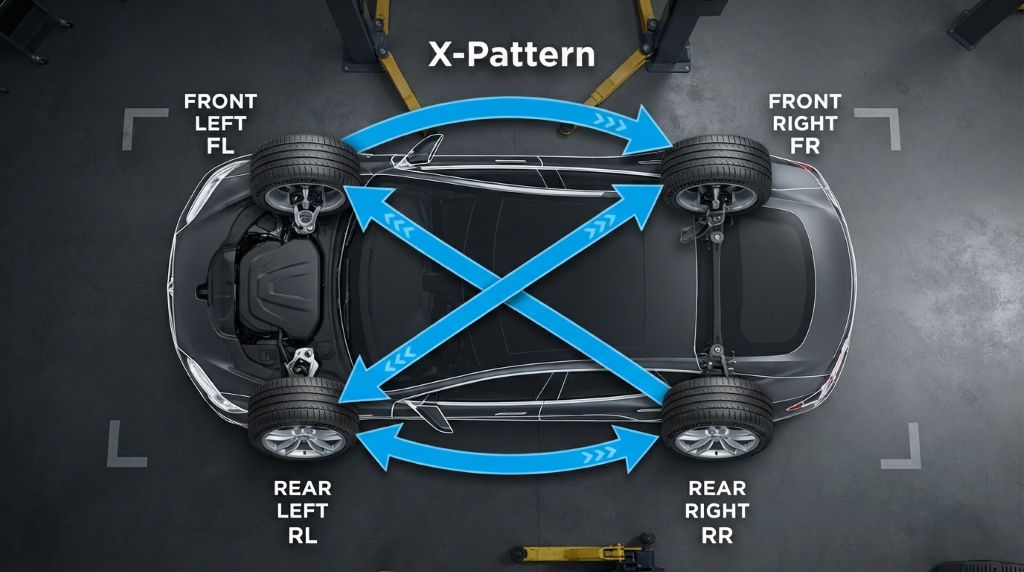
- X-pattern: all four tires swap diagonally. This works for many vehicles with same-size tires.
- Side to side: tires swap left and right on the same axle. This applies to directional tires with a one-way tread design.
Directional tires need special care. Their tread channels water in one direction only, so they can never cross sides. Additionally, some staggered setups use wider tires in the rear that cannot move to the front at all. Therefore, side-to-side becomes the only option.
If this sounds confusing, relax. Tire shops handle the pattern automatically, and they record it on your invoice. Most shops charge $20 to $50 for the service. Many dealers include rotation free with scheduled maintenance. Therefore, ask about bundled deals before you pay separately.
One final note on rotation timing. Always rotate before the wear difference grows too large. Once front tires drop more than 2/32 of an inch below the rears, rotating creates new handling quirks. Some owners report brief pull or noise after late rotations. Therefore, stay ahead of the wear, and the transitions stay invisible.
How to Build a Rotation Habit That Sticks
Good intentions fade; however, simple systems last. Here is how to make rotation automatic:
- Write the mileage interval inside your owner’s manual.
- Set a recurring phone reminder for every 5,000 miles.
- Ask for rotation every time you book an oil change.
- Keep all service records in one folder or app.
- Check tread depth with a penny whenever you check tire pressure.
Pairing with oil changes does most of the work. Almost every driver visits a shop for oil anyway, so the tires ride along at no extra mental cost. Additionally, while the wheels are off, the technician can inspect brakes, suspension, and tread wear. This free inspection often catches small problems early.
Monthly pressure checks support the whole effort. According to AAA, proper tire pressure improves safety, fuel economy, and tire life all at once. NHTSA recommends checking pressure monthly because tires naturally lose air over time. Underinflated tires wear on the shoulders and run hot. Therefore, pressure and rotation work as a team.
Record keeping pays off at resale too. A folder showing regular rotations proves careful ownership. Buyers and dealers pay more for documented maintenance. Therefore, those small receipts add real value when you sell the car.
Final Thoughts
So, how often should tires be rotated? Every 5,000 to 7,500 miles, ideally alongside each oil change. Watch for uneven tread, new road noise, and highway vibration. Then rotate on schedule, use the correct pattern, and keep the receipts. If you regularly drive long distances or have passengers who experience discomfort on the road, these 9 comfort tips to help car sick passengers feel better fast may also make your journeys more comfortable.
My $600 mistake taught me that uneven wear hides in plain sight. The car felt normal while the tires quietly drifted apart. Therefore, I now rotate every oil change without exception, and my current tires are wearing like a matched set.
Walk outside tonight and run the penny test on all four tires. If the depths differ, book a rotation this week. Have you ever discovered uneven tire wear too late? Share your story in the comments below. Additionally, share this guide with a friend who has never once rotated their tires. They will thank you at their next tire purchase.
Frequently Asked Questions
How often should tires be rotated on average?
Every 5,000 to 7,500 miles. Pairing the job with oil changes makes the schedule easy to follow.
What happens if I never rotate my tires?
Front tires wear out early while rear tread remains. You replace all four sooner and lose grip in wet weather.
How long does a tire rotation take?
A shop typically finishes in 30 to 45 minutes. Many complete it during your oil change appointment.
Can I rotate my own tires?
Yes, if you have a jack, stands, and the correct torque wrench. Follow the pattern in your owner’s manual.
Do directional tires need rotation?
Yes, but only side to side on the same axle. Their one-way tread can never cross to the other side.