You just unboxed your new paddle board, flipped it over, and spotted the fin box. Your heart sinks. Do you need a screwdriver, Allen wrench, or a degree in marine engineering just to hit the water? The frustration is real, especially when you are eager to paddle and the sun is burning. But here is the secret: most modern paddle boards are designed for a no-tool SUP fin installation, allowing you to swap fins in seconds with nothing but your bare hands. This guide will walk you through every method, from slide-in click systems to tool-free thumbscrews, ensuring you never miss a wave because you left your toolkit at home.
We will break down the mechanics of the three main fin systems (US Box, Click Fin, and Tool-Free Thumbscrew), provide step-by-step visual instructions, and troubleshoot common pitfalls. By the end, you will possess the knowledge to install, adjust, and remove fins confidently. Let’s get you paddling.
What Exactly is a No-Tool SUP Fin Installation System?
A no-tool SUP fin installation system is a mechanical design that allows the fin to be securely locked into the board’s fin box without requiring external instruments like screwdrivers or hex keys. Instead, these systems rely on spring-loaded pins, rotating levers, or hand-tightened screws built directly into the fin or the box itself. This design philosophy prioritizes convenience and accessibility for paddlers of all skill levels.
The primary goal is to reduce friction between the paddler and the water. Whether you are a surfer adjusting to wave conditions or a tourer swapping fins for speed, immediate adjustability is crucial. Most manufacturers have shifted to these systems on recreational and intermediate boards, realizing that requiring tools creates a barrier to entry. Let’s dive deeper.
Why Modern Boards Are Ditching Traditional Tools
Traditional fin installation requires a Phillips head screwdriver or a small Allen wrench to tighten a set screw against the fin base. While reliable, this method has several drawbacks: lost screws, stripped threads, and the inconvenience of carrying tools. The industry response has been the proliferation of proprietary no-tool systems, which offer a “click” or “snap” that provides audible and physical confirmation of a secure fit. This shift is not just about convenience; it is about safety—a loose fin can be a hazard.
The Core Components of a Tool-Free Fin Box
Understanding the parts helps demystify the process. A typical tool-free system consists of the fin box (a channel recessed into the board), the fin itself (which has a base plate or plug), and a locking mechanism (usually a spring-loaded ball bearing or a rotating cam). The fin base slides into the box, and the locking mechanism engages with a notch or hole to prevent movement. Unlike older systems, there is no separate screw to manage.
How Do You Install a Fin in a US Box Without Tools?
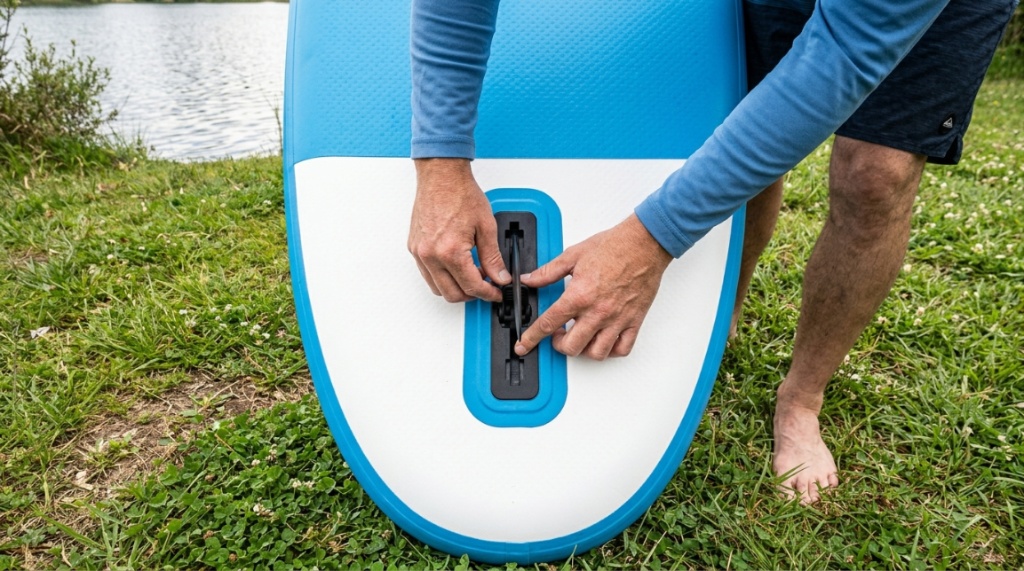
Installing a fin in a standard US Fin Box without tools is generally not possible unless the fin has an integrated tool-free mechanism, such as a lever or a spring pin. However, there is a rising trend of “tool-free compatible” fins that use a universal sliding wedge design. If you have a classic US Box with a standard screw hole, you typically need a screwdriver. But let’s explore the alternatives that actually work.
If your board has a US Box, the easiest path to a no-tool SUP fin installation is to purchase a fin that comes with a thumb nut or a built-in handle that tightens the screw manually. These fins often feature a larger, knurled head that you can spin with your fingers. They are an excellent upgrade for older boards.
Step-by-Step: Using a Thumb Screw Fin
First, identify the front of the fin and align it with the front of the fin box. Slide the fin’s base plate into the track at a slight angle, ensuring it sits flush against the bottom of the board. Next, locate the integrated thumbscrew on the side or top of the fin base. Rotate the thumbscrew clockwise until it makes contact with the fin box’s internal rail. Continue turning until snug, but do not over-torque.
When to Use a Wedge or Shim for a Snug Fit
Sometimes, an older fin box may have slight play. Tool-free systems often include small rubber shims or wedges that you can insert alongside the fin base to eliminate vibration and rattling. If your fin feels loose after locking, check if the system includes a wedge. Inserting this wedge is part of the tool-free process and requires only your fingers.
What is the Click Fin System and How Does it Work?
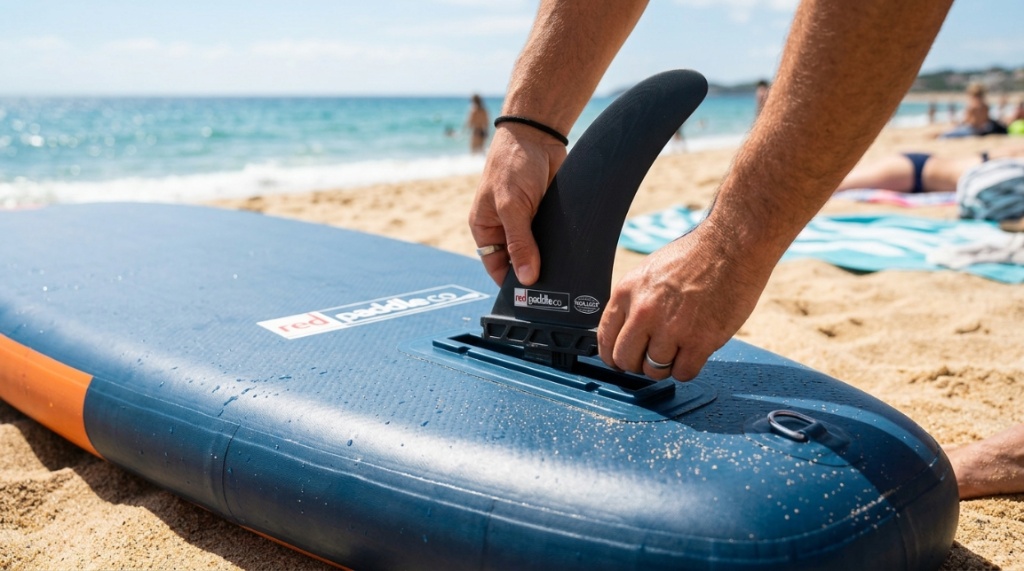
The Click Fin system is the most popular no-tool setup on the market today, pioneered by brands like Red Paddle Co. It features a spring-loaded pin integrated into the fin box that automatically retracts as you push a release button. This is the purest form of no-tool SUP fin installation, as it involves zero rotating or screwing. It’s strictly push-button and slide.
This system is designed specifically for quick changes in the water or on the beach. The mechanism is robust and sealed against sand and salt. When you slide the fin in, it automatically clicks into place, providing a reassuring “click” sound that signals a secure lock. To release, you press the button on the side of the fin box and pull the fin out,Once your fin is securely snapped into place and you are ready to hit the water, keeping your footing secure is the next priority. To prevent slipping and maximize your stance control, you can improve board stability with anti-slip surf shoes before stepping onto your deck.
How to Engage the Click Fin Mechanism
Align the fin’s pin slot with the button on the fin box. Push the fin fully forward until it stops. The spring-loaded pin will snap into the hole on the fin base. Gently tug the fin to ensure it is locked. There is no tool, no screw, no hassle. It is a true “click-and-go” system that is incredibly reliable.
Comparing Click Fin vs. Traditional Tooled Fins
Click systems are undeniably faster, but they are generally more expensive to replace. Traditional tooled fins offer infinite adjustability in terms of jib (trim) angle, whereas click systems are typically fixed or offer two position options. For the vast majority of paddlers, the speed of the click system outweighs the lack of micro-adjustments.
Are FCS and Futures Systems Tool-Free? A Quick Guide
Yes and no. FCS (Fin Control System) and Futures are primarily surfboard fin systems, but some SUP manufacturers utilize them. The standard FCS II system is completely tool-free, using a spring-loaded lever that you can flip with your thumb. The Futures system, on the other hand, still requires a tiny Allen key (usually 3/16″) to tighten grub screws. However, there are tool-free alternatives like the FCS II for those looking to avoid tools.
If you own a SUP with a Futures box, you are not cut off from the tool-free world. You can purchase a “Tool-Free Futures Adapter” or a fin that includes a plastic screw cap that you can tighten by hand. However, these are less common than the integrated FCS II system.
Identifying Your Fin Box Type
Before installing anything, check the fin box. Look for a brand name or logo inside. If you see a large lever mechanism, it’s FCS II. If you see two small screw holes, it’s Futures or a standard US Box. Knowing this determines your path. If you find small screw holes, you are back to the thumbscrew route.
The FCS II Tool-Free Lever Mechanism
The FCS II system uses a two-stage lever. To insert the fin, you press the lever down (open position), slide the fin into the box, and pull the lever up (closed position). This action engages pins that lock into the fin. It is effortless and rarely fails, making it a favorite among wave riders.
Why Should You Switch to a No-Tool Fin System?
Switching to a no-tool fin system eliminates the biggest pain point in paddle board ownership: the dreaded “fin screw” that rolls under the car seat. It saves time, reduces frustration, and allows you to adjust your fin while standing on the shore or even in shallow water. It makes the sport more accessible to beginners who might be intimidated by mechanical parts.
Beyond convenience, these systems are often more reliable in the long run because there are no small metal screws to corrode or strip. The plastic or stainless-steel locking mechanisms are designed for repeated use. This reliability builds confidence, knowing your fin will not fall off in the middle of a session.
Time Saving Benefits of Tool-Free Fins
Measure the time it takes to install a screw-based fin: find the screw, align it, screw it in, risk dropping it. That’s a 2-minute task. A no-tool installation takes 5 seconds. Over a year of paddling, this saves hours of your life. It also means you are more likely to swap fins to match conditions, improving your overall efficiency on the water.
Reducing the Risk of Lost Parts
Losing a fin screw is the most common reason for a delayed paddle. With a no-tool system, there is simply nothing to lose. The locking mechanism is either attached to the board (Click Fin) or integrated into the fin itself (Thumbscrew). This inherent design eliminates the #1 cause of on-water equipment failure.
How Do You Remove a Stuck Fin Without Tools?
If a fin is stuck, it is usually due to sand or salt buildup jamming the track. First, apply downward pressure on the release button or lever. While pressing, try wiggling the fin side-to-side while pulling backward. If this fails, flush the fin box with fresh water using a bottle or your hand to wash out debris. Do not use metal tools on a plastic box, as you will damage the locking teeth.
In extreme cases, a rubber mallet (a tool, admittedly) can help tap the fin out, but a better trick is to use a plastic card or old credit card to slide between the fin base and the box to break the suction. If you are stuck with a screw-based fin, the best tip is to use a coin (like a quarter) as a makeshift screwdriver in a pinch.
Preventative Maintenance for Tool-Free Systems
Rinse your fin boxes with fresh water after every session in the ocean to prevent salt crystallization. Lubricate the spring mechanisms with a silicone spray (not WD-40, which attracts dirt) once a month. This ensures the buttons and levers move freely.
Common Causes of Seized Fins
The most common cause is gritty sand acting as an abrasive paste between the fin and the box. Another cause is UV degradation of the plastic if the board is left in the sun. Regular rinsing and applying a thin layer of fin wax to the fin base can prevent sticking.
Which Fin Kits Offer the Best Value for Tool-Free Installation?
When looking for a fin kit, focus on the material and the locking mechanism. A nylon or polycarbonate fin with a click system is the best value for beginners due to its durability and low cost. Fiberglass fins offer better flex but are more expensive. The best value “kit” generally includes 2-3 fins of varying sizes (small, medium, large) that all fit the same tool-free box.
If you are in Florida or similar flat-water areas, a kick-up fin kit is invaluable. These fins fold back when they hit the bottom, preventing damage to the fin box. Many of these kick-up fins use a simple bungee or magnetic retention system that requires no tools for adjustment.
Comparing Materials: Plastic vs. Fiberglass for Tool-Free Use
Plastic fins are heavier and stiffer, but they are incredibly forgiving and cheap to replace. Fiberglass fins are lighter and provide better flex, translating to better performance, but they can crack if you hit a rock. For a no-tool system, plastic is often the better choice because the locking mechanism interfaces with a rigid material that won’t flex under pressure.
Top Brands Offering Tool-Free Fins
Red Paddle Co. is the leader with their Click Fin system. Starboard offers a tool-free “Smart Lock” system on some models. FCS II is the gold standard for surf-style boards. When purchasing, ensure the fin box is compatible with the fin brand. Using a mismatched brand can be a headache.
Can You Retrofit an Older Board With a No-Tool Fin System?
Yes, but with limitations. If your board has a standard US Fin Box, you can easily replace the screw with a tool-free bolt. These bolts, often called “Fuse” or “Glide” bolts, have an extended handle that you can twist by hand. Simply remove the old screw and insert the tool-free one. It takes 2 minutes and costs under $10.
If your board has a “cutout” or a proprietary box, retrofitting is harder. You generally cannot change the fin box itself without cutting into the board’s foam, which voids the warranty. The safest and most effective retrofit is the tool-free screw conversion.
Upgrading Your Current Fin Screw to a Thumb Nut
Here is a quick pro tip: visit a local hardware store with your current fin screw. Find a bolt of the same size (usually M6 or 1/4-20) but with a “knurled head” or “thumb” style head. Coat it in marine grease to prevent corrosion. This is the ultimate budget hack for no-tool SUP fin installation on an old board.
Adapters: Converting a Standard Box to Tool-Free
There are aftermarket adapters that include a cam-lock mechanism that fits inside a standard US Box. However, these are niche and can be expensive. They work by sliding into the box and then clamping from the inside. You then slide your fin into the adapter. Only recommend this if you are comfortable with a more complex assembly.
How To Ensure a Secure Fit for Your Tool-Free Fin?
Ensure your fin is secure by listening for a definitive click or by ensuring the thumbscrew is tightly snug against the box. Once installed, grab the fin and try to wiggle it. There should be zero play in a forward/backward direction. A small amount of lateral flex is normal for the material, but if it moves side-to-side, it is not locked properly.
During your first few paddles, check the fin tightening mechanism after 10 minutes. Sometimes, due to vibration, a “push-in” system might not seat fully. A quick push on the button or an extra quarter turn on the screw will set it. This habit will prevent losing a fin on the water.
Testing the Lock: Push, Twist, and Tug
Use the “Push, Twist, Tug” method. Push down on the spring button to ensure it is flush. Twist the locking lever or thumbscrew to ensure it is in the locked position. Tug firmly on the fin to test resistance. This 3-second check becomes muscle memory.
Adjusting Fin Pitch and Position
Some tool-free systems allow you to adjust fin pitch (the angle of the fin relative to the board) without tools. If your system has a mechanism to loosen the pivot point, do it on land and reset the angle. For most click fins, the pitch is fixed. For systems like the FCS II, the pitch is set based on the fin’s own template.
Frequently Asked Questions
Can I install a . . . Click Fin on a US Box board?
No. Click Fin systems use a proprietary box designed specifically for that fin’s base shape. A Click Fin will not physically fit into a standard US Box track. You must purchase fins that match your board’s fin box type.
Is a no-tool fin less secure than a screw-based fin?
No. Modern spring-loaded mechanisms are engineered to withstand the forces of paddling and surfing, often exceeding the retention of a simple screw. The audible “click” provides positive confirmation that the fin is locked securely.
What if my release button on my SUP fin is stuck?
First, rinse with fresh water to remove sand. Apply a silicone lubricant directly into the button’s seam. If it remains stuck, use a plastic pry bar to gently lift the fin while a friend presses the button. Do not force it with metal tools.
Are there tool-free fins for inflatable SUPs?
Yes, all inflatable SUPs are now sold with tool-free fins (usually Click Fin or a slide-in wedge), as they must be flat-packed for storage. The fin boxes on iSUPs are typically glued onto the drop-stitch fabric.
How often should I replace my tool-free fin?
A well-maintained plastic fin can last years. Inspect the locking edge for cracks or wear every season. If the fin appears chalky or brittle, replace it to prevent failure during a strong paddle.
Can I use a tool-free fin with a wakeboard or water ski?
No. Water sports trailers use entirely different mounting systems. This guide is strictly for stand-up paddle boards and surfboards. Do not attempt to interchange them.
What is the best tool-free system for surfing?
The FCS II system is widely considered the best for surfing due to its low-profile and high-strength lever lock. For SUP surfing, the Click Fin system is also highly favored for its reliability in shallow water.
Conclusion: Embrace the No-Tool Revolution for Faster Paddles
Installing your SUP fin should never be the hardest part of your day. The move toward no-tool SUP fin installation is not just a gimmick; it is a fundamental improvement in user experience that removes barriers between you and the water. Whether you choose a board with an integrated click fin or retrofit your trusty old board with a thumbscrew, the benefits are clear: faster setup, no lost parts, and greater confidence in your equipment.
We encourage you to check your board’s fin box today and practice the installation sequence. Learn the click, feel the snugness of the thumbscrew, and inspect the mechanism. The more comfortable you are with this simple task, the more enjoyable your time on the water will be. So, go ahead—ditch the screwdriver, keep your hands free, and get paddling.