
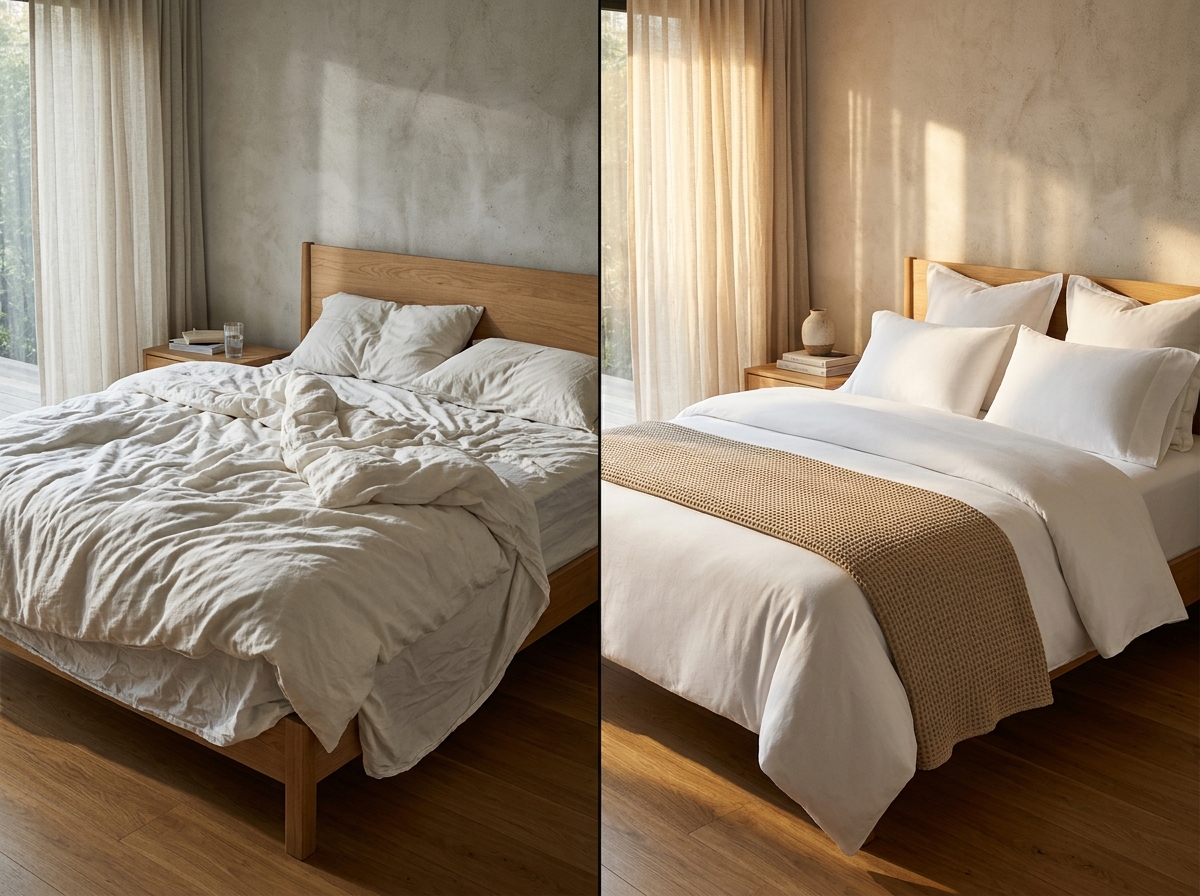
You’ve smoothed the duvet, fluffed the pillows, and stepped back—only to notice that your bed looks flat and slightly rumpled, nothing like the layered, inviting setup in the catalog photo. The culprit is usually not your styling skills. It’s almost always a size mismatch hiding in plain sight. Before you buy another decorative sham or rearrange your entire bedroom, it helps to understand the dimensions of a queen-size pillow //pillowshowcase.com/pillow-faq-guides/pillow-size-and-dimensions-chart and how they interact with your bedding. Once you see where the gaps are coming from, fixing them becomes surprisingly straightforward.
Quick Answer
Magazine beds look better because the pillows are properly sized and proportioned to the mattress, and they’re layered intentionally. A standard queen pillow measures roughly 20 by 30 inches, which leaves visible gaps on a 60-inch-wide queen mattress if you only use two. The fix: use two standard queen pillows as the base layer, add a slightly overfilled or king-size pillow behind them for height, and finish with one or two smaller accent pillows in front. Correct sizing plus layering is the real difference.
Key Takeaways
- A standard queen pillow is about 20 x 30 inches, so two of them cover only part of a 60-inch-wide queen mattress—leaving the bare spots that make beds look unfinished.
- Magazine beds rely on layering: a functional sleeping pillow layer, a supportive middle layer, and a decorative front layer.
- Overfilled pillows, not just larger ones, create the plump, upright look that flat pillows can’t achieve.
- Pillow protectors, inserts that are one size up, and a good pillowcase fit matter more than expensive decorative shams.
- You don’t need to match the photo exactly. A three-layer system sized to your mattress will look intentional without constant re-fluffing.
Why Your Bed Looks Flat Compared to the Photos
The photos you see are styled, but the styling isn’t random. Three specific problems cause most real beds to look flat, and each one has a concrete cause.
First, pillow coverage. A queen mattress is 60 inches wide. Two standard queen pillows at 20 inches each cover 40 inches, leaving roughly 10 inches of bare mattress on each side. That exposed strip is what makes the bed look sparse. Second, pillow fill. Most pillows sold as “standard” are underfilled relative to their casing, so they slump instead of standing up. Styled beds use pillows that are firm enough to hold a shape. Third, layering. A single row of pillows is functional, but it isn’t visually dimensional. Magazines almost always show at least two layers, and often three.
Understanding the Dimensions That Actually Matter
The measurements that affect how a bed looks are the pillow’s width, its height when filled, and how it sits relative to the mattress width. Here’s how the common sizes compare for a queen bed.
| Pillow Size | Typical Dimensions | Best Use on a Queen Bed |
|---|---|---|
| Standard | About 20 x 26 inches | Accent or single-sleeper use; leaves large gaps across a queen |
| Queen | About 20 x 30 inches | The standard sleeping pillow; two side by side still leave side gaps |
| King | About 20 x 36 inches | Creates fuller coverage and a taller back layer on a queen bed |
| Euro sham | About 26 x 26 inches | Large square back layer for height and a tailored look |
Notice that the queen pillow is only four inches longer than a standard one. That difference is small, but it matters at the edges. If you’ve ever bought “queen” pillows and still ended up with gaps, this is why.
The Three-Layer Pillow System That Fixes the Look
Magazine beds are built in layers, and you can replicate the same structure. Here’s the practical breakdown.
Layer 1: The functional sleeping pillows
These go against the headboard and do the actual work at night. Use two queen pillows for a queen bed. Choose a firm or medium-firm fill so they stand upright rather than collapsing. This layer determines the overall height of the arrangement, so it’s worth getting right.
Layer 2: The height and coverage layer
This is where most people miss the trick. Add two king-size pillows or two euro shams behind or beside the sleeping pillows. Their extra width fills the side gaps that queen pillows leave, and their size adds height. Euro shams work especially well because their square shape reads as deliberate and structured.
Layer 3: The decorative front layer
One or two smaller accent pillows sit in front. These can be lumbar pillows, small squares, or a single long bolster. This layer adds the finishing touch and breaks up the visual weight of the larger pillows behind it. It’s decorative only, so you can change it seasonally without disrupting the base.
Why Overfilled Beats Oversized
A common mistake is assuming that a bigger pillow automatically looks better. In practice, fill matters more than dimensions. A 20 x 30 pillow that’s generously filled holds its shape and stands up on its own. The same pillow with loose fill flattens within an hour of making the bed.
When shopping, look for pillows described as firm, extra-fill, or overstuffed if your goal is the upright catalog look. If you already own soft pillows, you can improve their appearance by inserting them into a slightly smaller pillowcase or using a pillow insert one size larger than the cover—this compresses the fill and creates a fuller shape. That single adjustment can transform a droopy pillow into one that stands at attention.
Pillowcases and Shams: The Details That Sell the Look
Even perfectly sized pillows can look sloppy if the covers don’t fit. A pillowcase that’s too loose wrinkles and bunches. A sham that’s too tight pulls at the corners and won’t lie flat.
Match the case to the pillow size rather than guessing. A queen pillow needs a queen case. For decorative shams, the insert should be the same size as the cover or one size larger if you want a fuller look. Also consider the closure style: envelope closures hide the pillow edge cleanly, while zippered shams give a sharper, more tailored result. These small differences are what separate a bed that looks “made” from one that looks styled.
Common Mistakes That Undo Your Effort
Even with the right sizes and layers, a few habits can flatten the whole effect.
- Using too few pillows. Two pillows on a queen bed are functional, not styled. Add the middle and front layers.
- Mixing sizes randomly. A standard pillow next to a king pillow creates an uneven line at the top. Keep each layer consistent in size.
- Ignoring the mattress gap. If your pillows don’t span the width, the bare mattress shows. Use wider pillows or add a third pillow to the base layer.
- Skipping the fluff. Pillows need to be shaken and reshaped each morning. It takes ten seconds and makes the difference between flat and full.
- Overloading the front. Too many small accent pillows crowd the bed and make it look cluttered rather than inviting.
Matching the Setup to Your Actual Mattress
Not every queen bed is identical in how it presents, and the right pillow setup depends partly on your mattress and headboard.
If you have a tall headboard, you have vertical space to work with, so taller layers and euro shams work well. For low headboards or bed frames without one, keep layers shorter so the pillows don’t tower over the bed. Additionally, an extra-thick mattress or plush topper can cause pillows to sit lower relative to the sleeping surface, making them look smaller than they actually are. In that case, adding a king pillow as the back layer restores proportion.
The goal isn’t to match a photo exactly. It’s to make the bed look balanced for its own dimensions, and that’s a matter of coverage, height, and layering working together.
Frequently Asked Questions
What size pillow goes on a queen bed?
Standard queen pillows, about 20 x 30 inches, are the typical sleeping pillow for a queen bed. For a fuller, styled look, many people use two queen pillows as the base and add king pillows or euro shams behind them.
How many pillows should a queen bed have?
A functional minimum is two, but a styled setup usually uses four to six: two sleeping pillows, two larger pillows or shams behind them, and one or two accent pillows in front.
Can I use king pillows on a queen bed?
Yes. King pillows work well as a back layer because their extra width covers the side gaps that queen pillows leave. They’re usually too large as a front accent pillow, though.
Why do my pillows look flat even after fluffing?
The fill is likely too soft for the casing. Pillows described as firm or overstuffed hold their shape better. Using a pillow insert one size larger than the cover can also create a fuller look.
Do euro shams help a bed look styled?
They can. Euro shams are large squares, about 26 x 26 inches, that add height and a structured, tailored appearance. They work best as a back layer, especially with a taller headboard.
How do I stop the bare mattress from showing at the sides?
Add width to the base layer. Either use wider pillows, such as king-size, or add a third pillow across the back. Two standard queen pillows alone rarely cover a 60-inch queen mattress fully.
Conclusion
The gap between your bed and the magazine photo usually comes down to three things: pillow coverage, fill quality, and layering. Start by choosing pillows wide enough to span your mattress. Next, upgrade to firmer, fuller inserts that actually hold their shape. Finally, nail the layering by building a sturdy base, a height layer, and a decorative front. None of these require expensive bedding—just the right sizes and a few minutes each morning. Start with the base layer, add height behind it, and finish with one accent pillow. That’s the whole system.


