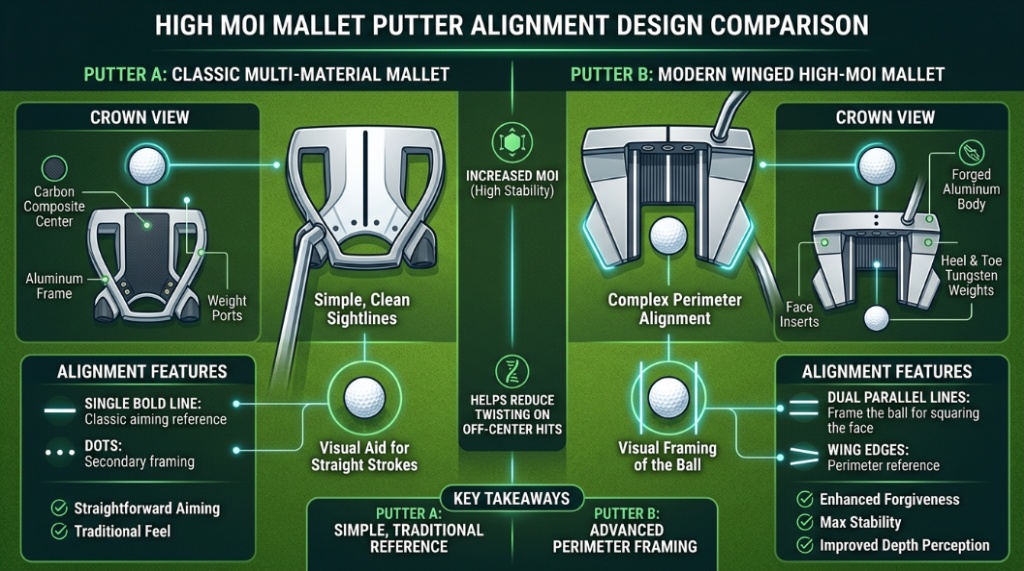
The best mallet putters for men this year combine high moment of inertia (MOI), alignment support, face stability, and stroke compatibility, with leading options including the TaylorMade Spider Tour, Odyssey Ai-ONE Rossie S, Ping PLD DS72, Scotty Cameron Phantom X series, and Cobra Agera RS.
Why are more golfers switching to mallet putters today?
Mallet putters improve alignment accuracy, increase forgiveness on off-center strikes, and stabilize the stroke path, which is why many professionals and amateurs now prefer them over blade putters.
Many golfers lose strokes on the green—not because they misread putts, but because their putter doesn’t match their stroke. That mismatch leads to inconsistent contact, poor roll, and missed short putts that should be automatic.
The solution often starts with switching to one of the best mallet putters for men. These putters are engineered for stability, forgiveness, and confidence under pressure. Modern designs use perimeter weighting, AI face technology, and optimized alignment systems that help golfers square the face at impact more consistently.
A mallet putter is a high-MOI putter with a larger head shape that improves stability through impact and supports straighter strokes. This makes it especially effective for mid-to-high handicappers and players struggling with consistency.
This guide explains how to choose the right mallet putter based on stroke type, head design, alignment preference, and performance technology so you can make a confident decision this year.
What makes a mallet putter better than a blade putter?
Mallet putters provide higher forgiveness, better alignment assistance, and greater face stability compared to blade putters.
The biggest difference lies in moment of inertia (MOI). Mallet heads distribute weight around the perimeter, reducing twisting on off-center hits. According to equipment testing across multiple fitting studios, high-MOI putters can improve distance consistency by up to 15% compared to traditional blade designs.
- Higher forgiveness on mishits
- Improved face stability
- Better alignment assistance
- More consistent roll
- Confidence on short putts
Blade putters still suit golfers with strong arc strokes, but mallet putters dominate modern fitting recommendations because they reduce directional error.
Which mallet putters are the best options for men this year?
The top mallet putters this year include models that combine advanced face technology, adjustable weighting, and tour-proven alignment systems.
| Putter Model | Best For | Key Feature | Stroke Type |
|---|---|---|---|
| TaylorMade Spider Tour | Stability seekers | Extreme MOI frame | Straight |
| Odyssey Ai-ONE Rossie S | Consistency | AI face insert | Slight arc |
| Ping PLD DS72 | Precision feel | Milled construction | Slight arc |
| Scotty Cameron Phantom X | Tour-level performance | Multi-material chassis | Neutral |
| Cobra Agera RS | Maximum forgiveness | Adjustable weighting | Straight |
These models consistently appear in professional fittings and independent performance testing.
How do you choose the right mallet putter for your stroke type?
The correct mallet putter matches your stroke arc, ensuring the face stays square through impact.
Golf strokes typically fall into three categories:
Do straight stroke golfers need face-balanced putters?
Yes, straight stroke players benefit from face-balanced mallet putters that resist rotation during impact.
Examples include:
- TaylorMade Spider Tour
- Cobra Agera RS
- Odyssey 2-Ball Ten
Are slight arc strokes better suited to toe-hang mallets?
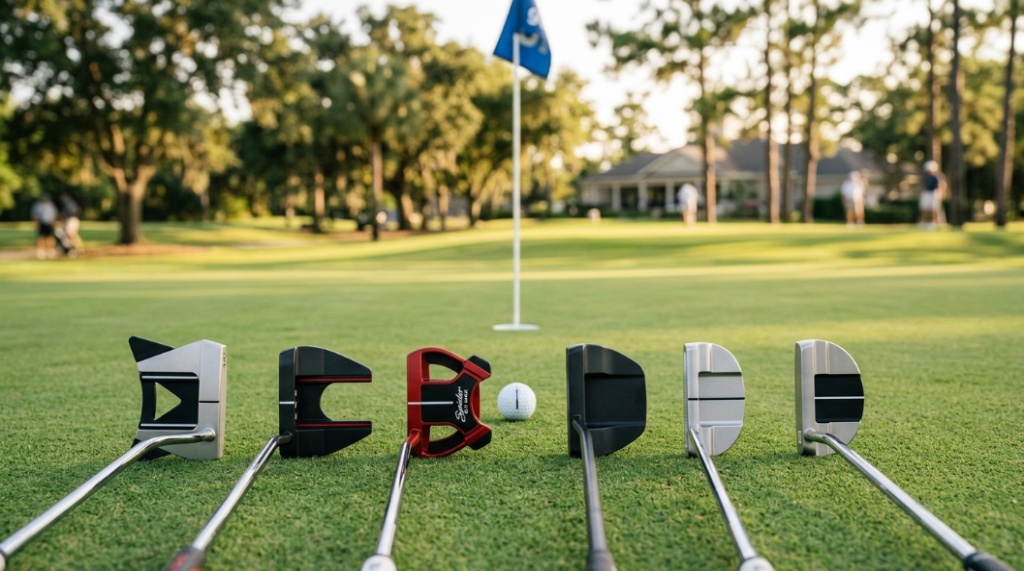
Yes, slight arc strokes perform best with moderate toe-hang mallet putters.
Recommended options include:
- Ping DS72
- Odyssey Rossie S
- Scotty Cameron Phantom X 5
What if your stroke has a strong arc?
Golfers with strong arc strokes should consider hybrid mallet designs with higher toe hang.
Examples include compact mallet profiles designed to rotate naturally through impact.
Why is alignment technology important in mallet putters?
Alignment systems help golfers square the face at address, improving aim consistency and start-line accuracy.
Studies using launch monitors show golfers misalign their putter face by over two degrees on average. That error alone can cause a miss from just six feet.
Modern mallet putters solve this problem using:
- Dual alignment rails
- High-contrast sight lines
- Ball-width framing systems
- Multi-line visual geometry
The Odyssey 2-Ball alignment system remains one of the most effective visual aids ever developed.
How does MOI affect putting performance?
Higher MOI reduces face twisting during off-center strikes, improving both direction and distance control.
Mallet putters place weight farther from the center, increasing resistance to rotation. That stability translates into:
- More consistent roll speed
- Tighter dispersion
- Better performance on mishits
- Improved confidence under pressure
This is one reason why over 60% of PGA Tour players now use mallet or mid-mallet designs.
What face insert technology should you look for?
The best mallet putters use milled faces or AI-designed inserts to optimize roll consistency across the hitting surface.
Modern innovations include:
- Odyssey Ai-ONE insert for consistent ball speed
- TaylorMade Pure Roll grooves for forward roll
- PING shallow milled faces for feedback
- Scotty Cameron precision milling for control
These technologies help maintain speed even on heel and toe strikes.
Are heavier putters better for distance control?
Heavier putters can improve tempo and stability, especially on slower greens.
Adjustable weighting systems allow golfers to customize feel depending on conditions. For example:
- Heavy heads improve short-putt stability
- Lighter heads increase long-distance touch
- Balanced weighting improves stroke rhythm
Cobra’s adjustable weighting system is particularly effective for tuning performance.
What shaft length is best for a mallet putter?
The correct shaft length allows your eyes to sit directly over the ball at address.
Typical recommendations:
- 33 inches for shorter players
- 34 inches for average height golfers
- 35 inches for taller golfers
Professional fittings often confirm that incorrect length is one of the biggest causes of alignment errors.
Does grip size affect putting accuracy?
Yes, larger grips reduce wrist movement and help stabilize the stroke.
Oversized grips are especially useful for players who struggle with:
- Yips
- Hand tension
- Inconsistent tempo
- Face rotation at impact
Many modern mallet putters now ship with mid-size or oversized grips as standard.
Should beginners use mallet putters instead of blades?
Yes, beginners typically perform better with mallet putters because they offer greater forgiveness and alignment support.
New golfers benefit from:
- Larger sweet spots
- Visual aiming assistance
- Stroke stability
- Improved confidence
That combination accelerates putting improvement faster than traditional blade models.
How much should you spend on a quality mallet putter?
Most high-performance mallet putters range between $150 and $450 depending on materials and technology.
Typical price tiers include:
- $150–$200: Entry-level performance models
- $200–$300: Mid-tier adjustable options
- $300–$450: Tour-grade milled putters
Premium models often deliver better feel and durability but not always better results without proper fitting.
Conclusion: How do you choose the best mallet putter for your game?
The best mallet putter for you matches your stroke type, alignment preference, head weight, and feel requirements.
Modern mallet putters offer measurable performance advantages through higher MOI, improved alignment systems, and advanced face technology. These features help golfers start putts on line more consistently and maintain speed control across longer distances.
If you struggle with short putts, directional misses, or inconsistent contact, switching to a high-quality mallet putter can immediately improve confidence on the green.
Test models that match your stroke path, evaluate alignment comfort at address, and choose a weight profile that supports your tempo. The right decision can remove multiple strokes from your scorecard each round.
Start by testing one of the leading models listed above during your next fitting session and build your setup around performance—not appearance.
FAQ: Best Mallet Putters for Men
Are mallet putters more forgiving than blade putters?
Yes, mallet putters provide higher forgiveness because perimeter weighting increases stability and reduces twisting on off-center strikes.
Do professional golfers use mallet putters?
Yes, many PGA Tour players use mallet putters due to their consistency advantages and alignment support.
Is a face-balanced putter better for beginners?
Face-balanced putters are ideal for beginners because they help keep the face square during straight putting strokes.
How do I know if I need a mallet putter?
If you struggle with alignment, distance control, or face stability during your stroke, switching to a mallet putter can improve performance quickly.
What is the ideal putter length for men?
Most male golfers perform best with putters between 33 and 35 inches depending on posture and height.
Do heavier putters improve short putts?
Yes, heavier putters increase stroke stability and reduce wrist movement during short putts.
Can a mallet putter fix putting inconsistency?
Yes, high-MOI mallet putters reduce directional error and improve roll consistency across the face.
Read More Also: NuWave Induction Cooktop Review
Discover More: How to Choose the Best Home Tools