

Living in a small space doesn’t mean sacrificing the convenience of modern kitchen appliances. However, choosing the right microwave for limited counter or cabinet space requires careful consideration of size, features, and functionality. The wrong choice can overwhelm your kitchen, while the perfect fit maximizes both your space and cooking capabilities.
Many people struggle with finding appliances that balance performance with spatial efficiency. A microwave that’s too large dominates your limited counter area, leaving no room for meal preparation. Conversely, a model that’s too small may not meet your cooking needs, forcing you to seek alternative heating methods.
This comprehensive guide will walk you through everything you need to know about selecting a microwave that works perfectly in your compact living situation. You’ll discover how to evaluate your space, understand different microwave types, and identify features that matter most for small-space living.
Measuring Your Available Space
Before you start shopping, you need accurate measurements of where your microwave will live. This step prevents the frustration of buying an appliance that doesn’t fit or blocks important workspace.
Start by measuring the width, depth, and height of your intended location. If you plan to place the microwave on a counter, measure the available space carefully. Remember to account for items you can’t move, like coffee makers or dish racks that occupy permanent spots.
Don’t forget about clearance requirements. Microwaves need ventilation space to operate safely and efficiently. Most manufacturers recommend at least three inches of clearance on the sides and back. The top typically needs four to six inches of breathing room.
Additionally, consider the door swing. Microwaves with doors that open to the left or right need extra space in front. Measure to ensure the door can open fully without hitting walls, cabinets, or other appliances. Some models offer doors that drop down, which can be more space-efficient in certain layouts.
Think about electrical outlet locations too. Your microwave needs to plug in somewhere, and extension cords aren’t recommended for high-wattage appliances. Make sure an outlet exists within reach of your chosen spot.
Understanding Different Microwave Types
Microwaves come in several configurations, each with advantages and disadvantages for small-space living. Knowing the differences helps you make an informed decision based on your specific situation.
Countertop models are the most common and versatile option. They simply sit on your counter and plug into a standard outlet. These units are easy to install, move if needed, and replace when they wear out. However, they consume valuable counter space that might be at a premium in a small kitchen.
Over-the-range microwaves mount above your stove, combining a microwave with a range hood. This configuration saves counter space by utilizing vertical space. Nevertheless, installation is more complex and usually requires professional help. They also limit your ability to rearrange your kitchen layout in the future.
Built-in microwaves install into cabinetry for a seamless look. They free up counter space and create a custom appearance. Yet, they’re the most expensive option and require cabinet modifications. This choice works best if you own your space and plan to stay long-term.
Microwave drawers slide out like a cabinet drawer, offering easy access and unique styling. They install below counters or in islands, saving counter space. However, they carry a premium price tag and aren’t practical for most renters.
Compact appliances designed specifically for small spaces offer the best balance for many apartment dwellers. These scaled-down models provide essential microwave functions while occupying minimal space.
Determining the Right Size
Size matters enormously when selecting a microwave for limited space. The key is finding the sweet spot between capacity and footprint.
Interior capacity is measured in cubic feet. A dorm microwave oven typically ranges from 0.5 to 0.9 cubic feet, suitable for heating single servings and small plates. These tiny units fit almost anywhere but limit what you can cook.
Mid-sized models between 0.9 and 1.3 cubic feet handle most standard dinner plates and medium containers. They strike a good balance for individuals or couples. Most apartment microwaves fall into this category, offering reasonable capacity without dominating your counter.
Larger compact models from 1.3 to 1.6 cubic feet can accommodate larger dishes and casseroles. They work well for small families or those who cook more elaborate meals. However, verify your available space before choosing this size.
The exterior dimensions matter just as much as interior capacity. Two microwaves with the same interior space can have different footprints based on insulation thickness and design efficiency. Always check exterior measurements, not just capacity.
Consider turntable diameter as well. A larger turntable means more usable space for oddly shaped containers. Some models offer rectangular interiors without turntables, maximizing usable space in a compact footprint.
Evaluating Power and Performance
Wattage determines how quickly and evenly your microwave heats food. Understanding power ratings helps you set realistic expectations for cooking times and results.
Most compact microwaves range from 600 to 1,000 watts. Lower wattage units take longer to heat food but use less electricity. They work fine for basic reheating but struggle with actual cooking tasks.
Mid-range power between 800 and 900 watts provides good performance for most tasks. These microwaves heat food reasonably quickly and handle everything from reheating leftovers to cooking microwave meals.
Higher wattage models above 900 watts deliver the fastest heating and most even cooking. They excel at defrosting and cooking raw ingredients. However, they may draw more power than older apartment circuits can handle safely.
Check your recipe conversion needs too. Many microwave recipes assume 1,000-watt power levels. If you choose a lower wattage model, you’ll need to adjust cooking times upward. Some experimentation may be necessary to get good results.
Power levels and control options matter for cooking versatility. Multiple power settings let you defrost gently, warm carefully, or heat aggressively. This flexibility improves results across different food types.
Essential Features for Small Spaces
Certain features become particularly valuable when you’re working with limited kitchen space. Prioritizing these capabilities ensures you get maximum utility from your appliance.
One-touch cooking presets simplify common tasks like popping popcorn, reheating beverages, or defrosting meat. These shortcuts save time and reduce the learning curve. Look for presets that match your actual cooking habits.
Sensor cooking technology detects moisture released by food and automatically adjusts cooking time. This feature prevents overcooking and eliminates guesswork. It’s especially helpful for reheating leftovers to the perfect temperature.
Quick-start or express cooking buttons let you add cooking time in 30-second increments with a single touch. This convenience speeds up simple reheating tasks when you don’t need precise timing.
Child safety locks prevent accidental operation, which matters in shared living spaces or if you have young visitors. This feature gives peace of mind that the microwave won’t run unsupervised.
Interior lighting helps you monitor cooking progress without opening the door. Bright, even lighting is surprisingly rare in budget models but makes a real difference in usability.
Turntable on/off options provide flexibility for heating large rectangular dishes. Being able to stop the turntable expands your usable interior space when needed.
Design and Aesthetic Considerations
Your microwave will be visible in your small space, so appearance matters more than it might in a large kitchen with abundant cabinet storage.
Color and finish should complement your existing appliances and decor. Stainless steel looks modern and matches most appliances but shows fingerprints easily. Black models hide smudges better and create a sleek appearance. White units blend into many kitchens and often cost less.
Control panel layout affects both appearance and usability. Touch controls create a smooth, modern look and are easy to clean. However, traditional buttons provide tactile feedback and work better for those who cook without looking directly at the controls.
Door handle design impacts the overall footprint. Recessed handles save space compared to protruding handles that extend beyond the unit’s profile. Some models eliminate handles entirely, using push-button door releases.
Additionally, consider viewing window size. Larger windows let you monitor food better but may indicate less insulation. Smaller windows suggest better energy efficiency but limit visibility.
Display brightness matters if your kitchen lacks overhead lighting. A bright display helps you see settings in dim conditions but may seem too bright at night in a studio apartment.
Installation and Placement Options
How and where you install your microwave significantly impacts your kitchen’s functionality and flow. Think creatively about placement to maximize your limited space.
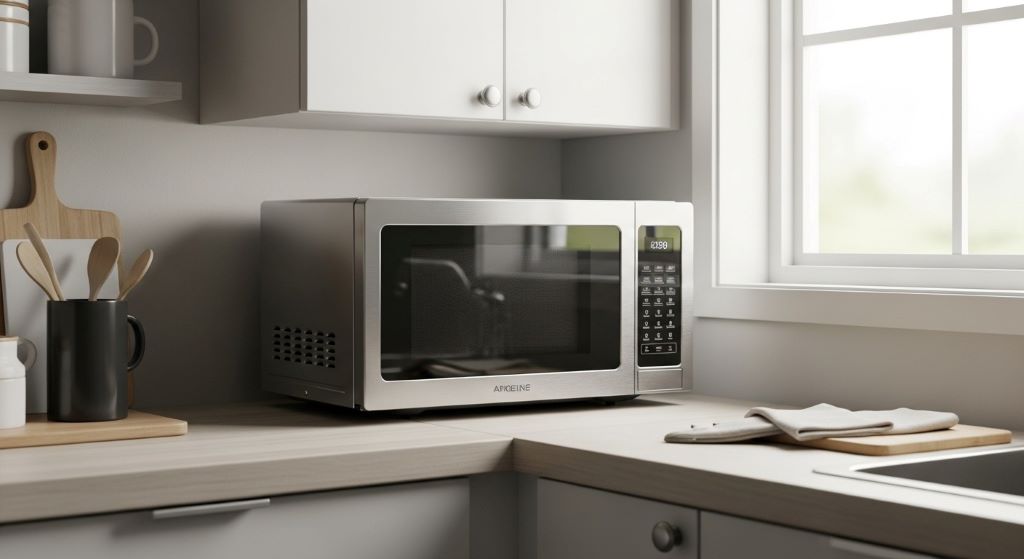
Counter placement is the simplest option but uses premium workspace. Consider positioning the microwave in a corner to minimize its impact on your main prep area. Alternatively, place it on a small cart that can roll away when not needed.
Shelf mounting frees up counter space by elevating the microwave. Install a sturdy shelf at a comfortable height, ensuring it can support the weight. This option works well in rentals if you choose damage-free mounting systems.
Under-cabinet placement utilizes the space beneath wall cabinets. Special mounting kits let you hang certain countertop models, keeping them accessible while clearing your counter. Verify your microwave is compatible with this installation method.
Cart or island placement provides flexibility and mobility. A small kitchen cart can hold your microwave and create additional storage underneath. This solution works especially well in spaces where permanent installation isn’t possible.
Closet or pantry installation might seem unconventional, but it works if you have a nearby closet with electrical access. This approach completely removes the microwave from your cooking area, though it reduces convenience.
Energy Efficiency Matters
In a small space, every appliance’s energy consumption contributes to your utility bills and environmental impact. Understanding efficiency helps you make a responsible choice.
Energy Star certification indicates the microwave meets strict efficiency guidelines. These models use less electricity in standby mode and during operation. The savings may seem small, but they add up over years of use.
Standby power consumption varies widely between models. Some microwaves draw significant power even when not in use, just to maintain the clock and settings. Look for models with eco modes or efficient standby consumption.
Inverter technology provides more efficient heating compared to traditional transformers. Inverters deliver consistent power levels rather than cycling on and off. This results in faster, more even heating while using less energy.
Proper size selection improves efficiency too. An oversized microwave wastes energy heating a large cavity for small portions. Conversely, running a tiny microwave multiple times to heat a large dish uses more energy than doing it once in an appropriately sized unit.
Furthermore, good insulation keeps heat inside the cavity where it belongs. Well-insulated microwaves cook more efficiently and keep their exteriors cooler, which matters when they’re sitting on a counter you might touch.
Special Considerations for Renters
Renting adds unique constraints to appliance selection. Your microwave choice should work with your current space while remaining practical for future moves.
Portability becomes important if you move frequently. Lighter models are easier to pack and transport. Consider keeping the original box for protection during moves, though this requires storage space.
Damage-free installation methods protect your security deposit. Avoid options that require drilling into walls or cabinets. Stick with countertop models or use removable adhesive mounting systems if you need to save counter space.
Landlord restrictions may limit your choices. Some lease agreements prohibit certain modifications or appliance types. Review your lease before purchasing a microwave that requires installation.
Resale value matters if you plan to sell the microwave when you move. Popular sizes and neutral colors sell more easily. Specialty units or unusual colors may be harder to sell secondhand.
Additionally, consider your lease duration. If you’re only staying six months, a basic model makes more sense than a premium unit. For longer leases, investing in quality improves your daily experience.
Cleaning and Maintenance
In a small space, cleanliness becomes even more important. A dirty microwave contributes to kitchen odors and creates an unpleasant environment.
Interior coating affects cleaning ease. Ceramic or enamel interiors wipe clean easily and resist staining. Stainless steel looks nice but shows every splatter. Painted interiors are budget-friendly but may stain over time.
Removable turntables simplify cleaning by allowing you to wash them in the sink. Look for dishwasher-safe turntables if you have access to a dishwasher.
Splatter covers prevent messes before they happen. A microwave-safe cover protects the interior from food splatters, reducing cleaning frequency. Some models include covers, or you can purchase them separately.
Regular maintenance extends your microwave’s life. Wipe spills immediately, deep clean monthly, and check the door seal periodically. Replace the unit if the door doesn’t close tightly or if you notice arcing inside.
Odor control becomes important in small apartments where kitchen smells permeate living spaces. Clean your microwave regularly with vinegar and water to eliminate absorbed odors. Some models include odor-removal features.
Budget Planning
Microwaves span a wide price range, and understanding what you get at different price points helps you make a smart investment.
Basic models under one hundred dollars provide essential microwave functions without frills. They work fine for simple reheating but may lack durability or advanced features. These suit students or very temporary living situations.
Mid-range options between one hundred and two hundred dollars offer better construction, more features, and improved reliability. Most people find the best value in this price bracket. These microwaves balance performance with affordability.
Premium compact models above two hundred dollars deliver superior performance, build quality, and features. They make sense for long-term use or serious cooking enthusiasts. The investment pays off through better results and longer lifespan.
Consider total cost of ownership beyond the purchase price. Energy-efficient models save money over time through lower electricity bills. Durable construction means fewer replacements. Warranty coverage protects against early failures.
Watch for sales during major shopping holidays. Retailers often discount microwaves significantly during Black Friday, after holidays, and during spring cleaning seasons. Patience can save you considerable money.
Making Your Final Decision
With all this information, you’re ready to make an informed choice. Creating a decision framework helps you prioritize what matters most.
List your must-have features based on your cooking habits. If you frequently heat large plates, interior capacity matters more than a slim profile. If counter space is extremely limited, footprint becomes the priority.
Create a shortlist of models that fit your space and budget. Read user reviews focusing on reliability, actual capacity, and real-world performance. Professional reviews provide technical details, but user experiences reveal everyday usability.
Compare specifications side-by-side for your finalists. Look at wattage, capacity, dimensions, and features. Check warranty terms and brand reputation for customer service.
Visit stores to see models in person when possible. Photos don’t always convey actual size well. Seeing and touching the controls helps you assess build quality and ease of use.
Trust your instincts about what feels right for your space and lifestyle. The perfect microwave balances technical specs with practical considerations unique to your situation.
Conclusion
Selecting the right microwave for a small kitchen or apartment requires balancing size, features, and functionality within your space constraints. Compact appliances designed for limited spaces, including specialized dorm microwave ovens and apartment microwaves, offer the performance you need without overwhelming your kitchen.
Start by accurately measuring your available space and understanding clearance requirements. Consider different microwave types and determine which configuration works best for your living situation. Evaluate size carefully, balancing interior capacity with exterior footprint. Power levels and essential features should align with your cooking habits and needs.
Remember that design matters in small spaces where appliances remain visible. Installation flexibility can help you maximize your limited square footage creatively. Energy efficiency reduces operating costs while supporting environmental responsibility. Renters should prioritize portability and damage-free installation options.
Set a realistic budget based on your needs and how long you plan to use the microwave. The perfect choice combines the right size, appropriate features, and good value for your specific situation. With careful consideration of all these factors, you’ll find a microwave that enhances your small-space kitchen rather than cluttering it.
Frequently Asked Questions
What size microwave is best for a studio apartment?
For most studio apartments, a microwave between 0.9 and 1.2 cubic feet offers the best balance. This size handles standard dinner plates and most food containers while maintaining a manageable footprint. Measure your available counter space first, ensuring at least three inches of clearance on all sides. If you primarily reheat prepared foods and beverages, a smaller 0.7 cubic foot model may suffice and save valuable counter space.
Can I put a microwave in a cabinet or closet?
You can place a microwave in a cabinet or closet if proper ventilation exists. The space must allow adequate airflow with several inches of clearance on all sides and top. Never close the door while the microwave operates, as this creates dangerous heat buildup. Additionally, ensure an electrical outlet is readily accessible. Built-in microwaves are specifically designed for cabinet installation, while standard countertop models need more ventilation space.
How much wattage do I need in a small microwave?
For basic reheating and defrosting, 700 to 800 watts is adequate. For more versatile cooking including preparing microwave meals and cooking raw ingredients, choose 900 to 1,000 watts. Higher wattage cooks faster and more evenly but draws more power. If your apartment has older electrical systems, verify the circuit can handle your chosen wattage. Most modern apartments accommodate up to 1,200 watts without issues.
Are countertop microwaves better than over-the-range models for apartments?
Countertop models are generally better for apartments because they require no installation, remain portable when you move, and cost significantly less. Over-the-range microwaves save counter space but require professional installation and landlord permission for mounting. Unless you own your apartment and plan to stay long-term, countertop models offer more flexibility. They’re also easier to replace if problems occur.
How do I prevent my microwave from taking up too much counter space?
Consider vertical solutions like sturdy shelving or microwave carts with storage underneath. Some people successfully use under-cabinet mounting kits designed for countertop models. Corner placement maximizes space efficiency by using an area often underutilized. Rolling carts let you move the microwave when you need extra prep space. Alternatively, choose the smallest microwave that meets your needs, prioritizing a compact footprint over maximum capacity.
Related Topics:
Step-by-Step Guide to Organizing and Cleaning Kitchen
NuWave Induction Cooktop Review: Pros, Cons, and Cooking Experience