
Your hair talks to you every single day. It shows you when it is happy and when it is struggling. However, as the hair health experts at newjerseystylist.com/ warn, most of us ignore the signals until the damage becomes hard to fix. Dryness, breakage, and limp strands are not random problems. Each one points to a specific cause. Your hair either needs more water, more protein, or a break from your hot tools. Once you learn to read these signs, caring for your hair becomes much simpler. In this post, you will learn what your hair is telling you. You will also get simple fixes for each problem. Therefore, read on, because your best hair days start with listening.
Key Takeaways
- Dry, rough hair that snaps when stretched needs moisture.
- Mushy, overly stretchy hair that stretches without breaking needs protein.
- Flat, lifeless strands that look fried need less heat.
- Protein and moisture must stay balanced, or one ruins the other.
- Heat tools above 185°C damage keratin, according to published research.
- The wet strand stretch test tells you in seconds what your hair lacks.
What Your Hair Is Really Telling You
Hair is mostly a protein called keratin. It also holds water inside the strand. Therefore, healthy hair needs two things in balance. It needs enough protein for strength and enough moisture for softness. When one side drops, your hair sends clear warning signs. Think of it like a bank account. Protein is the savings and moisture is the daily spending. You cannot survive on one alone.
Researchers have studied this balance closely. According to research published in the Journal of Cosmetic Science, heat above 185°C (365°F) breaks down the hair’s inner protein structure. The study found that repeated exposure at high temperatures weakens strands from the inside. Additionally, a review in the International Journal of Trichology confirms that chemical treatments and heat both degrade keratin bonds over time.
So why should you care? Because guessing wastes money. Many people buy deep conditioners when their hair really needs protein. Others load up on protein masks when the real problem is plain dryness. As a result, the problem gets worse instead of better. Consequently, the first step is diagnosis, not shopping.
The good news is that your hair makes diagnosis easy. It shows moisture loss, protein loss, and heat damage in different ways. However, the signs overlap sometimes, which confuses people. In the next sections, you will learn each set of signs one by one. You will also learn a simple wet test that takes less than a minute. Therefore, keep reading before you buy another product.
Signs Your Hair Needs More Moisture
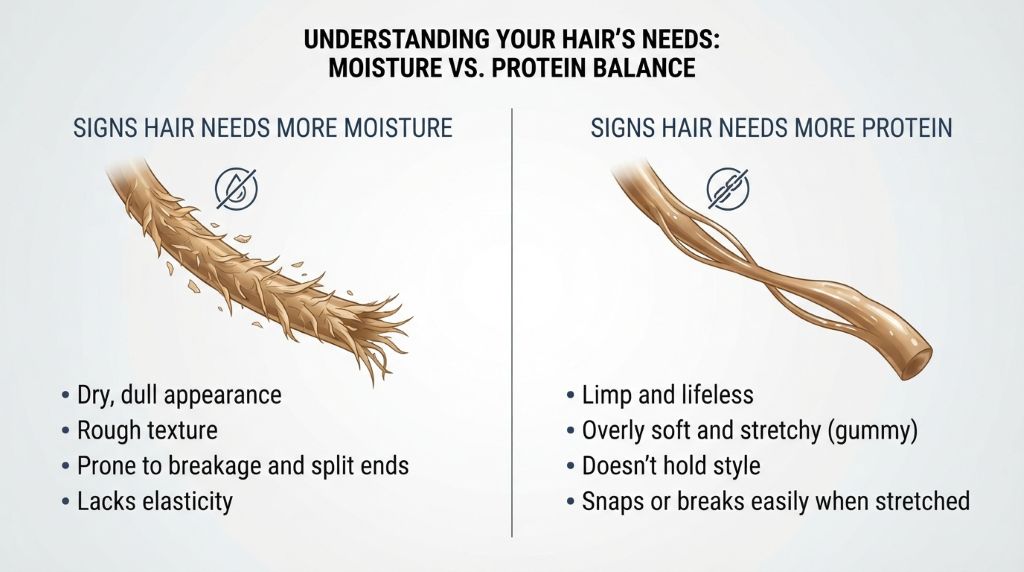
Dry hair is the most common complaint, and the easiest to fix. However, people often mistake it for damage. Dryness means your hair lacks water and oil. Damage means the protein structure is broken. These are different problems with different solutions.
Below are the signs that your hair is thirsty.
- Your hair feels rough or straw-like, even after conditioning.
- The ends tangle fast and feel like they catch on each other.
- It looks dull instead of shiny, even in good lighting.
- Static and flyaways appear, especially in dry weather.
- The scalp feels tight, itchy, or flaky.
- Your hair soaks up products almost instantly.
Here is a simple test to confirm it. Wet a single strand and gently stretch it. If it snaps fast with almost no stretch, your hair is too dry. Healthy wet hair stretches a little and then returns to its shape. A study in the Journal of the Society of Cosmetic Chemists found that low moisture content lowers hair elasticity, meaning it stretches less before it breaks. Additionally, dry hair absorbs humidity from the air, which causes frizz on muggy days.
Therefore, the fix is hydration. Wash with a gentle, sulfate-free shampoo two or three times a week. Follow with a rinse-out conditioner and a weekly deep conditioning mask. Look for ingredients like glycerin, aloe vera, and panthenol, because these pull water into the strand. Additionally, seal the moisture in with a light oil such as argan or jojoba. However, remember that moisturizing alone will not fix broken protein. If your hair feels mushy and limp instead, read the next section carefully.
Signs Your Hair Needs More Protein
Protein is the building block of every strand. Heat, bleach, dye, and rough handling all chip away at it. When protein drops, hair loses its structure. Consequently, it starts behaving strangely in water. Protein-deficient hair is often described as mushy or gummy.
Below are the clearest signs.
- Wet hair feels soft but overly stretchy, almost like chewing gum.
- Strands stretch far and do not bounce back to their shape.
- Hair is limp and flat no matter what products you use.
- It loses curl definition and looks stringy.
- Strands break off mid-shaft without a clear snapping sound.
- The ends look thin and see-through, like spider webs.
Try the wet stretch test again here. If the strand stretches a long way before breaking, or hangs limp, your hair needs protein. Furthermore, trichologists often call this “over-moisturized” hair. It happens when people deep condition constantly without ever adding protein. The strand becomes waterlogged and loses its inner support. Therefore, protein and moisture work as a team, and too much of either causes trouble.
The fix is a protein treatment. Use a rinse-out protein conditioner first, because it is gentle. Look for ingredients like hydrolyzed keratin, wheat protein, or silk amino acids. Research published in the International Journal of Cosmetic Science shows that hydrolyzed proteins attach to damaged spots on the cuticle and fill the gaps. However, go slowly. Use one protein treatment every four to six weeks at first. Overdoing protein causes its own problem. Hair becomes stiff, dry, and brittle. Consequently, always follow a protein treatment with a moisturizing conditioner to restore balance. Additionally, if you bleach or color your hair often, you may need protein more regularly than someone who does not.
Signs You Need to Cut Back on Heat
Heat damage is the sneakiest of the three problems. A flat iron gives instant results, so people rarely connect it to long-term harm. However, every pass of a hot tool changes the inside of the strand. According to research published in the Journal of Cosmetic Science, temperatures above 185°C cause permanent changes to keratin. The study found that hair exposed to this level of heat loses strength and elasticity. Furthermore, high heat actually boils water inside the strand and creates tiny air bubbles that make it weak. Watch for these warning signs.
- Hair looks fried at the ends, even after a trim.
- The texture changes and will not hold any style.
- Curls that once bounced now hang straight or limp.
- Strands break easily and feel dry right after washing.
- Color fades much faster than it used to.
- Split ends appear within weeks of a trim.
Therefore, the fastest fix is a full heat break. Give your hair at least two to four weeks with zero hot tools. Air dry when you can. Additionally, if you must use heat, change how you use it. Keep flat irons and curling tools at or below 185°C. Many tools default to 230°C, which is far too hot for most hair types. Always apply a heat protectant first, because it slows down how fast the strand heats up. Moreover, one pass at a lower temperature beats ten passes at a high one.
Also rethink your blow dryer habits. Point the airflow downward along the strand to keep the cuticle flat. Use the medium setting instead of the hottest one. Consequently, your styles will last longer, and your hair will stay stronger. Remember, heat damage cannot be fully reversed. Therefore, prevention always beats repair. If the damage is severe, a trim is the only real cure, and deep treatments can only mask the rest.
Conclusion
Your hair gives you honest feedback every day. Rough, snapping strands mean it needs moisture. Stretchy, mushy strands mean it needs protein. Fried, stubborn texture means it needs a break from heat. Once you match the sign to the fix, you stop wasting money on the wrong products. Additionally, you protect the progress you already made. This is especially important when styling thinner hair, where a gentler approach can help maintain its appearance and reduce unnecessary stress. If you prefer a sleek look, learning how to style a slick back haircut on thinning hair can help you work with your hair rather than against it.
Start with the wet stretch test tonight. It takes one strand and thirty seconds. Therefore, check which category your hair falls into before your next wash day. Pick one change, stick with it for three weeks, and then reassess. Your hair will reward you with softness, bounce, and shine. So grab that strand, run the test, and give your hair exactly what it has been asking for.
FAQs
How do I know if my hair needs protein or moisture?
Do the wet stretch test. If a wet strand stretches far and feels mushy, you need protein. If it snaps quickly with little stretch, you need moisture. However, if it stretches slightly and bounces back, your hair is balanced.
Can you fix heat-damaged hair without cutting it?
You cannot fully reverse heat damage. Treatments and masks can mask it for a while. However, the fried part of the strand stays broken. Therefore, a trim removes the worst damage, and good habits stop new damage.
How often should I use a protein treatment?
Start with once every four to six weeks. Bleached or heavily colored hair may need it more often. However, watch for stiffness and dryness, because those are signs you are overdoing it.
Does air drying really make hair healthier?
Yes, it removes heat damage from your routine. However, hair is weak when wet, so handle it gently. Press out water with a microfiber towel instead of rubbing, and detangle with a wide-tooth comb.
Can too much moisture damage my hair?
Yes, it can. Over-conditioned hair becomes limp, stretchy, and prone to breakage. Trichologists call this hygral fatigue. Therefore, balance moisture with occasional protein treatments to keep strands strong.