
Key Takeaways
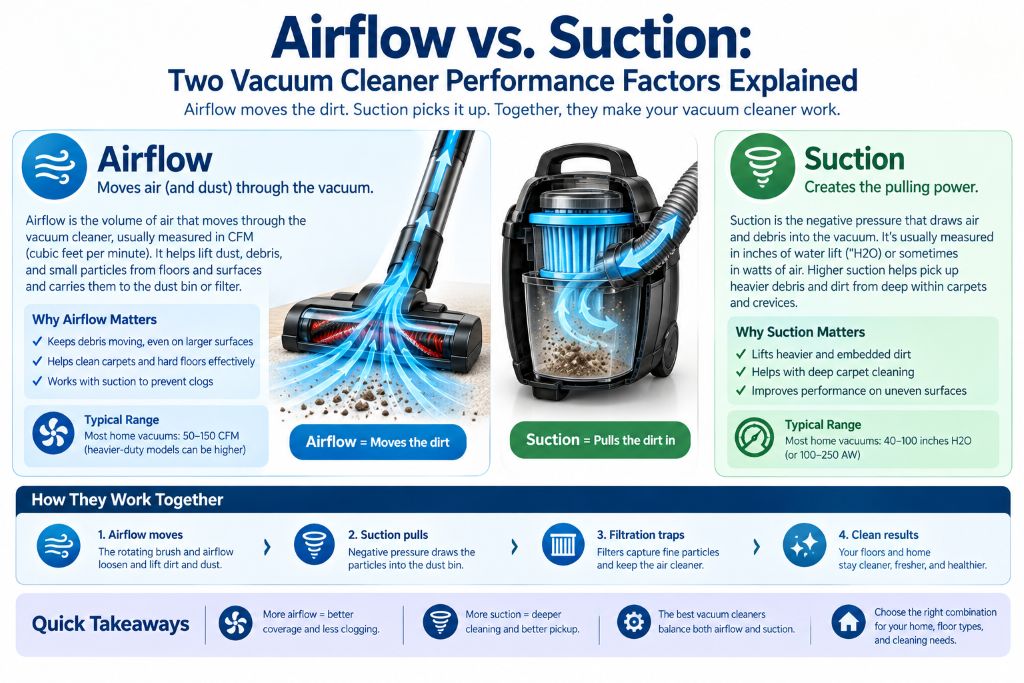
- Suction measures pulling force, usually shown as water lift in inches.
- Airflow measures moving air volume, usually shown as CFM.
- Suction lifts and loosens dirt, while airflow carries it away.
- A vacuum needs both factors working together for real cleaning power.
- Restriction in hoses and filters increases speed but can lower total airflow.
Vacuum shopping often centers on one number: suction power. However, suction alone does not clean a floor. Airflow plays an equally important, often overlooked role. Drawing on technical insights from industry resource //bestvacuumcleaner.us/, this guide explains both factors clearly so you understand what each measurement means and why balance matters most.
Two Different Measurements, One Shared Goal
Vacuum performance depends on two separate physical properties working together. Confusing them leads to poor buying decisions.
According to Vacuum Wars, airflow refers to the volume of air a vacuum moves per unit of time, typically measured in cubic feet per minute, or CFM. Suction power, by contrast, refers to the vacuum’s ability to create a pressure difference and pull matter by force, typically measured as water lift in inches.
A vacuum enthusiast forum post describes how these two factors work as partners during actual cleaning. Airflow is what makes dirt travel from carpet or upholstery into the bag or bin, while suction provides the lifting action that holds the nozzle against a surface. Neither factor alone completes the cleaning process.
This partnership explains a common testing frustration among reviewers. A cordless vacuum //bestvacuumcleaner.us/vacuum-cleaner/choose-a-cordless-vacuum-easy-home-cleaning/ testing guide found that some vacuums with strong suction still struggled on carpet and failed to move debris into the bin. The guide concludes plainly that suction alone doesn’t move debris; it just creates pull.
Understanding both measurements separately, then seeing how they interact, gives you a clearer picture of real cleaning performance. The next sections break down each factor individually before showing how they combine.
What Suction Actually Measures
Suction represents the pulling force your vacuum’s motor generates. Manufacturers typically express this force using a specific water-based test.
Vacuum Wars explains the testing method behind this number. Water lift comes from laboratory tests where a vacuum pulls a column of water straight up a tube, measuring how high that column rises in inches. A rating of 80 inches of water lift means the vacuum generates enough force to raise water 80 inches within that test tube.
A vacuum forum discussion adds an important technical clarification. Water lift, also called suction, is fundamentally a measure of pressure rather than a movement or volume of air. This distinction matters because pressure and volume describe genuinely different physical properties.
Suction serves specific, important functions during cleaning. A cordless vacuum guide lists these functions directly: lifting heavier debris, providing initial pickup force, and creating seal strength against surfaces. This last function explains why a vacuum head can stick tightly to carpet or a smooth floor.
However, suction has real limitations on its own. The same guide states clearly that high suction doesn’t guarantee strong cleaning performance. Without adequate airflow to carry debris away, strong pulling force alone cannot complete the cleaning job.
What Airflow Actually Measures
Airflow describes the volume of moving air passing through your vacuum system. This measurement captures a different physical property than suction entirely.
Vacuum Wars frames airflow simply. Higher CFM means the vacuum pulls more air, and therefore more dirt, through its intake and hose every minute. This flowing air acts as the transport mechanism carrying debris from your floor into the collection bin or bag.
A cordless vacuum comparison guide describes airflow’s role using a clear mental image. Airflow represents how much air is actually carrying debris through the vacuum. Without sufficient airflow, dirt has no reliable path to travel, even with strong suction pulling at the surface.
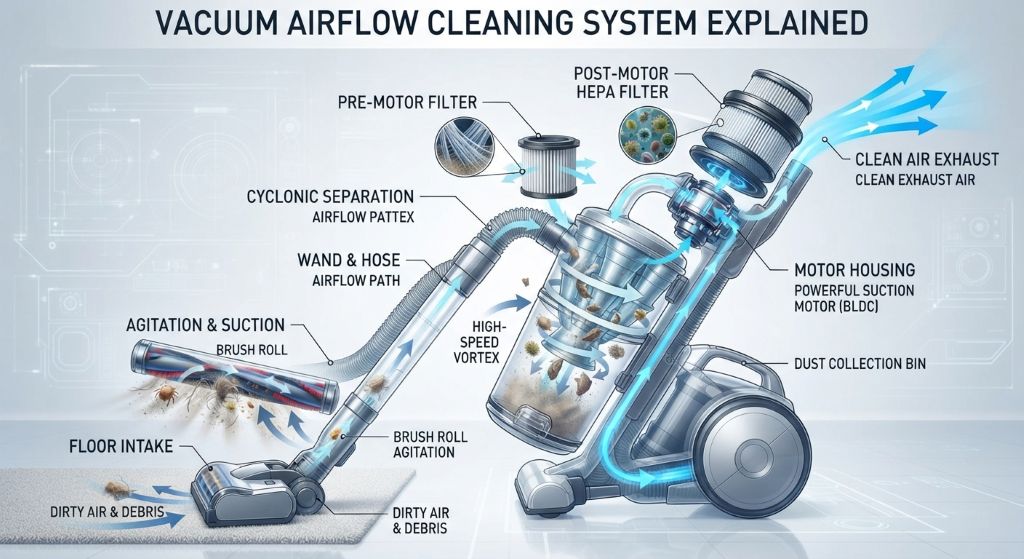
Several design factors influence actual airflow beyond motor strength alone. Vacuum Wars notes that airflow depends not only on motor power but also on the design of air pathways, filters, and the bag or canister system. A restrictive filter or narrow passage can reduce real-world airflow, even when the motor itself remains powerful.
This design dependency creates real variation between similar-looking vacuums. Two machines with identical motors can produce very different airflow results based on hose diameter, filter density, and internal pathway design. Therefore, airflow reflects the whole system’s efficiency, not motor power in isolation.
How Restriction Changes the Relationship
Suction and airflow interact in a specific, sometimes counterintuitive way. Restricting airflow actually increases air speed and pressure at the same time.
A vacuum forum discussion offers a helpful comparison to explain this relationship. A wide-open river carries the same water volume as a narrow one, but with less force since it faces no restriction. Narrowing that same flow forces the same volume through a smaller opening, increasing both speed and force.
The same source applies this principle directly to household appliances. A clothes dryer moves air largely unrestricted, so it simply carries moisture away without generating strong force. A vacuum, by contrast, deliberately restricts airflow through a narrow tube, which increases air speed and therefore increases the force applied to any given amount of moving air.
This trade-off appears clearly in comparisons between different air-moving systems. A woodworking dust collection guide explains this pattern using shop equipment as an example. As static pressure, another term for suction, increases, CFM tends to decrease within the same system. Consequently, engineers must choose which property to prioritize based on the specific job.
The same guide notes how different tools reflect this trade-off in their design goals. Large-area dust collection favors high CFM for moving air across long distances with low resistance. Meanwhile, systems handling fine dust from small tools favor high water lift specifically to overcome resistance in narrow passages. Vacuum cleaners generally fall into this second category.
Why Neither Number Works Alone
Marketing materials often highlight only one of these two measurements. However, real cleaning performance always depends on their combined balance.
A vacuum forum post makes this point directly. Having lots of one factor without enough of the other does not produce a well-performing vacuum. Achieving the right balance between suction and airflow is what actually creates effective cleaning results.
A cordless vacuum comparison guide breaks this balance down by specific cleaning scenario.
- Carpet cleaning: airflow matters more for carrying loosened debris away
- Heavy debris pickup: suction helps provide initial lifting force
- Overall performance: airflow combined with brush design wins consistently
- Sealed surfaces: suction creates the seal needed for effective cleaning
- Fine dust from small areas: both factors need careful balance together
This scenario-based thinking helps explain confusing product comparisons. A vacuum with impressive water lift numbers might still underperform if its airflow falls short. Conversely, high airflow without adequate suction may fail to loosen embedded dirt in the first place.
Industry testing methods reflect this same dual-factor approach. A vacuum forum notes that commercial testing relies on both CFM and inches of water lift as standard measurements. Historical vacuum marketing sometimes displayed both figures together on a two-dimensional graph, showing their relationship rather than promoting a single number alone.
Reading Specs and Testing Claims Correctly
Understanding these two measurements helps you evaluate vacuum specifications more critically. Manufacturers do not always make comparisons easy.
Follow these steps when comparing vacuum cleaning power claims.
- Check whether the spec sheet lists CFM, water lift, both, or neither.
- Remember that many uprights simply do not publish CFM figures at all.
- Look for independent reviews that measure airflow with an anemometer.
- Compare water lift figures only between models tested the same way.
- Prioritize airflow figures when your main concern is carpet cleaning.
- Treat single-number marketing claims with reasonable skepticism.
Vacuum Wars notes a common industry gap directly. Manufacturers usually don’t list CFM for upright vacuums, so independent reviewers often measure it themselves using a digital anemometer at the cleaning head or hose. This means shoppers frequently must rely on third-party testing rather than manufacturer specifications alone.
Water lift numbers also carry a specific limitation worth understanding. A detailed forum discussion states that water lift is essentially meaningless for cleaning dry particulate matter, since the measurement was originally designed for lifting water specifically. It represents pressure rather than the airflow needed to transport dry debris.
This distinction matters because CFM combines two genuinely necessary factors for dry cleaning. The same source explains that CFM captures both the volume of air carrying dirt and the speed at which that dirt moves toward the collection point. Therefore, airflow arguably deserves more shopper attention than suction, despite receiving less marketing emphasis.
Conclusion
Suction and airflow measure two different physical properties that work together during cleaning. Suction, measured as water lift, provides pulling force and surface seal strength. Airflow, measured in CFM, carries loosened debris away from the surface and into the vacuum. Restriction in hoses and filters increases speed and pressure but can reduce total airflow volume. Just as proper airflow helps a vacuum work efficiently, following a plumbing maintenance checklist for homeowners can help keep household water systems flowing smoothly and prevent avoidable blockages.
Understanding both factors helps you see past single-number marketing claims. Look for independent airflow testing alongside any suction figures before your next purchase. Compare vacuums using both measurements together, and choose a model that balances them well for your specific floors.
Frequently Asked Questions
What is the difference between suction and airflow in a vacuum?
Suction is pulling force, measured as water lift. Airflow is moving air volume, measured in CFM.
Which matters more for carpet cleaning, suction or airflow?
Airflow generally matters more for carrying loosened debris away from carpet fibers effectively.
Why does a narrow vacuum hose increase suction force?
Restricting airflow through a narrow opening increases air speed and pressure, similar to a narrowed river channel.
Can a vacuum have strong suction but weak cleaning performance?
Yes, high suction without adequate airflow often fails to move debris into the bin effectively.
Why don’t manufacturers always list CFM for vacuums?
Many upright vacuum makers skip this figure. Independent reviewers often measure it using an anemometer instead.