

Trading with limited capital presents unique challenges. Many beginners struggle to find methods that protect their accounts while allowing growth. The fractional-risk anchor candle method offers a solution. This approach combines risk management with technical analysis. Traders at Study of Stocks have found this strategy particularly effective for building confidence and consistency.
Understanding the Anchor Candle Concept
An anchor candle serves as your reference point. It’s a significant price bar that shows clear market direction. This candle typically has a larger body than surrounding candles. It often appears after a period of consolidation or indecision.
The anchor candle represents institutional activity. When large players enter the market, they create noticeable price movements. These movements leave footprints in the form of strong candles. Recognizing these patterns helps you trade alongside smart money rather than against it.
Why Fractional Risk Matters for Small Accounts
Many traders risk too much per trade. This aggressive approach often leads to account depletion. For those implementing small account trading strategies, fractional risk becomes essential. Instead of risking the traditional 1-2% per trade, you might risk 0.25-0.5%. This conservative approach provides breathing room.
Fractional risk allows you to survive multiple losing trades. Markets move unpredictably in the short term. Therefore, your strategy must accommodate inevitable losses. A small account cannot withstand large percentage drawdowns. Recovery from a 50% loss requires a 100% gain. Additionally, psychological damage from large losses often causes traders to abandon good strategies prematurely.
Setting Up Your Fractional-Risk Parameters
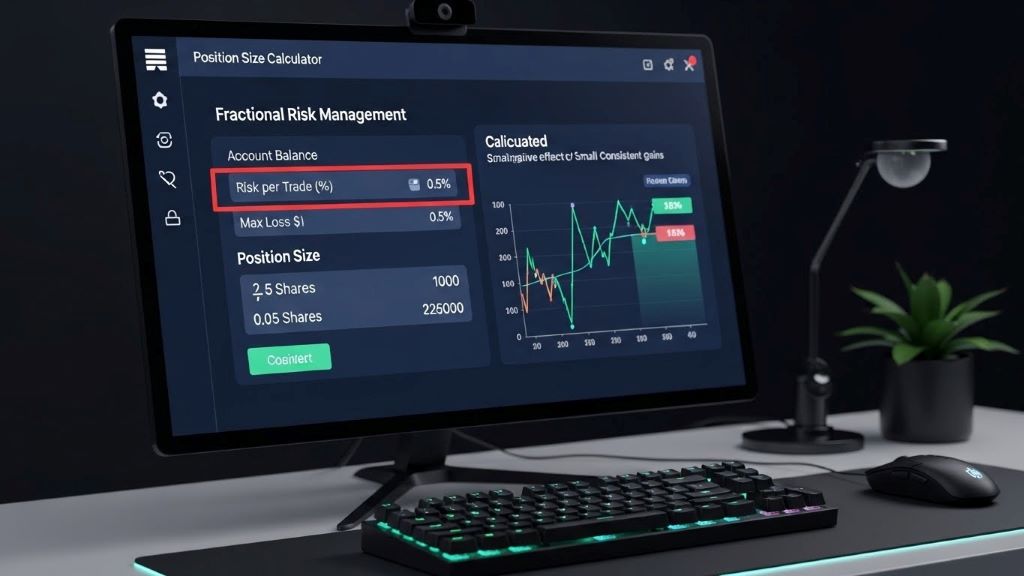
Start by determining your maximum risk tolerance. If you have a $1,000 account, decide how much you can afford to lose per trade. For fractional risk, consider 0.25-0.5% of your account. This equals $2.50 to $5.00 per trade on a thousand-dollar account.
Next, calculate position sizing based on your stop loss distance. The formula is simple: Risk Amount ÷ Stop Loss Distance = Position Size. For example, if you’re risking $5 and your stop loss is 50 cents away, you can buy 10 shares. This mathematical approach removes emotion from position sizing decisions.
Identifying Valid Anchor Candles
Not every large candle qualifies as an anchor. Valid anchor candles share specific characteristics. First, they should show strong directional movement with minimal wicks. The body should comprise at least 70% of the total candle range. Second, volume should exceed the recent average. According to Investopedia, volume confirmation adds credibility to price movements.
The anchor candle should also break through a significant level. This might be a previous high, low, or consolidation zone. Without this breakthrough, the candle lacks the institutional backing that makes the strategy reliable. Context matters as much as the candle itself.
Entry Strategies Using Anchor Candles
Once you’ve identified an anchor candle, wait for a pullback. Entering immediately often results in poor risk-reward ratios. Instead, allow the price to retrace toward the anchor candle’s midpoint or tail. This patience improves your entry price significantly.
Set your entry slightly above the pullback low for bullish setups. For bearish setups, enter slightly below the pullback high. This positioning ensures you’re entering with momentum resuming in your favor. However, don’t chase the price if it moves away quickly. Missed opportunities are better than forced trades.
Stop Loss Placement Techniques
Your stop loss should reference the anchor candle structure. For long positions, place stops below the anchor candle’s low. Add a small buffer to avoid stop hunts by market makers. This buffer might be 1-2% below the actual low depending on the asset’s volatility.
The stop loss distance directly affects your position size. Wider stops require smaller positions to maintain fractional risk. Conversely, tighter stops allow larger positions. Never adjust your risk amount to accommodate a larger position. The risk amount should remain constant while position size varies.
Profit Target Selection
Use a risk-reward ratio of at least 2:1. If you’re risking $5, aim for a $10 profit minimum. This ratio allows you to be profitable even with a 40% win rate. Many successful traders use 3:1 or higher ratios for small account growth.
Identify logical profit targets based on chart structure. Previous resistance levels make excellent targets for long positions. Support levels work well for short positions. Additionally, round numbers often act as psychological barriers where prices stall. Fibonacci extensions can provide mathematically derived target zones.
Managing Multiple Positions
With fractional risk, you can hold several positions simultaneously. However, ensure these trades aren’t highly correlated. Holding multiple positions in the same sector increases risk concentration. Diversification across different sectors or asset classes provides better protection.
Track your total account risk across all open positions. While individual trades risk 0.25-0.5%, your combined risk shouldn’t exceed 2-3% of account equity. This aggregate risk management prevents catastrophic losses from multiple simultaneous failures.
Common Mistakes to Avoid
Many traders increase position size after winning streaks. This mistake violates fractional risk principles. Your risk percentage should remain constant regardless of recent results. Emotional decision-making leads to inconsistent results and increased losses.
Another common error involves ignoring market context. An anchor candle appearing during a strong counter-trend might fail. Always consider the broader market structure. Trade with the trend whenever possible. Fighting the prevailing direction reduces your probability of success significantly.
Psychological Benefits of Fractional Risk
Small losses are easier to accept emotionally. When you risk only $2.50 per trade, losing trades don’t trigger fear responses. This emotional stability allows better decision-making. You can follow your trading plan without panic-induced deviations.
Furthermore, fractional risk builds confidence through consistency. Protecting your capital demonstrates discipline. As your account grows, you can gradually increase dollar risk while maintaining the same percentage. This approach creates sustainable growth rather than boom-bust cycles.
Tracking and Analyzing Your Results
Maintain a detailed trading journal. Record every trade’s entry, exit, anchor candle characteristics, and outcome. Over time, patterns emerge showing your strengths and weaknesses. Perhaps you perform better on bullish setups or struggle with Friday trades.
Calculate your win rate, average winner, and average loser monthly. These metrics reveal whether your strategy maintains positive expectancy. A strategy with 45% wins but 3:1 reward-risk ratio remains profitable. Regular analysis helps you refine your approach systematically.
Adapting the Strategy for Growth
As your account grows, your dollar risk increases while percentage remains constant. A $5,000 account risking 0.5% allows $25 per trade. This scaling happens naturally without requiring strategy changes. The fractional-risk anchor candle method grows with you.
Eventually, you might increase your risk percentage slightly. However, resist the temptation to become aggressive. Many traders destroy years of gains by abandoning the discipline that created their success. Slow, steady growth proves more sustainable than explosive gains followed by devastating losses.
Combining with Other Indicators
While the anchor candle provides your primary setup, additional confirmation helps. Moving averages show trend direction clearly. The 50-day and 200-day moving averages are particularly popular. Barron’s regularly discusses how institutional investors use these indicators for decision-making.
Relative Strength Index (RSI) can identify overbought or oversold conditions. When an anchor candle appears with RSI showing divergence, the setup becomes more reliable. However, avoid indicator overload. Too many signals create confusion rather than clarity.
Real-World Application Example
Imagine identifying a bullish anchor candle on a stock trading at $50. The candle has a low of $49.50 and closes at $51. Volume is twice the daily average. You wait for a pullback to $50.25. Your account size is $2,000, and you’re risking 0.5% ($10).
You place your stop at $49.40 (10 cents below the anchor low). The distance from entry to stop is 85 cents. Your position size is $10 ÷ $0.85 = 11.76 shares, rounded to 11 shares. Your profit target sits at $52.95 (3:1 ratio). This trade risks $10 to potentially make $30.
Conclusion
The fractional-risk anchor candle method provides a structured approach for small account traders. By combining minimal risk with clear technical setups, you protect capital while allowing growth. The anchor candle identifies high-probability entries backed by institutional activity. Meanwhile, fractional risk ensures survival through inevitable drawdowns.
Success requires patience and discipline. Wait for quality setups rather than forcing trades. Maintain consistent risk parameters across all market conditions. Track your results to identify areas for improvement. Over time, this methodical approach builds both your account and your trading skills. Remember that consistent small gains compound dramatically over months and years.
Frequently Asked Questions
What percentage should I risk per trade with a small account?
Risk between 0.25% and 0.5% per trade when using the fractional-risk method. This conservative approach allows you to withstand 20-40 consecutive losses before significant account damage. As your account grows and your skills improve, you might increase to 0.75%, but never exceed 1% on small accounts.
How do I identify a valid anchor candle?
Look for candles with large bodies (70%+ of total range), volume exceeding recent averages, and a break of significant price levels. The candle should show decisive directional movement. Additionally, context matters—anchor candles work best when aligned with the broader trend direction.
Can I use this strategy for day trading?
Yes, the fractional-risk anchor candle method works across timeframes. For day trading, use 5-minute or 15-minute charts to identify intraday anchor candles. However, ensure your broker’s commission structure doesn’t erode profits. Small position sizes combined with high commissions can make profitability difficult.
What markets work best for this strategy?
This strategy works well in stocks, forex, and futures markets. Liquidity is important, so focus on actively traded instruments. Avoid extremely volatile penny stocks or illiquid options. The method performs best on assets with clear trends and institutional participation.
How long should I wait for a pullback after an anchor candle?
Typically, wait 3-10 candles for a pullback to develop. If the price continues strongly without retracing, skip the trade. Chasing entries reduces your risk-reward ratio and increases failure probability. Patience is more profitable than forcing entries at poor prices.
Related Topics:
Striking Gold: A Comprehensive Guide to Starting Own Gold Mining Business
Managing Partner Definition: Duties, Authority, and Importance